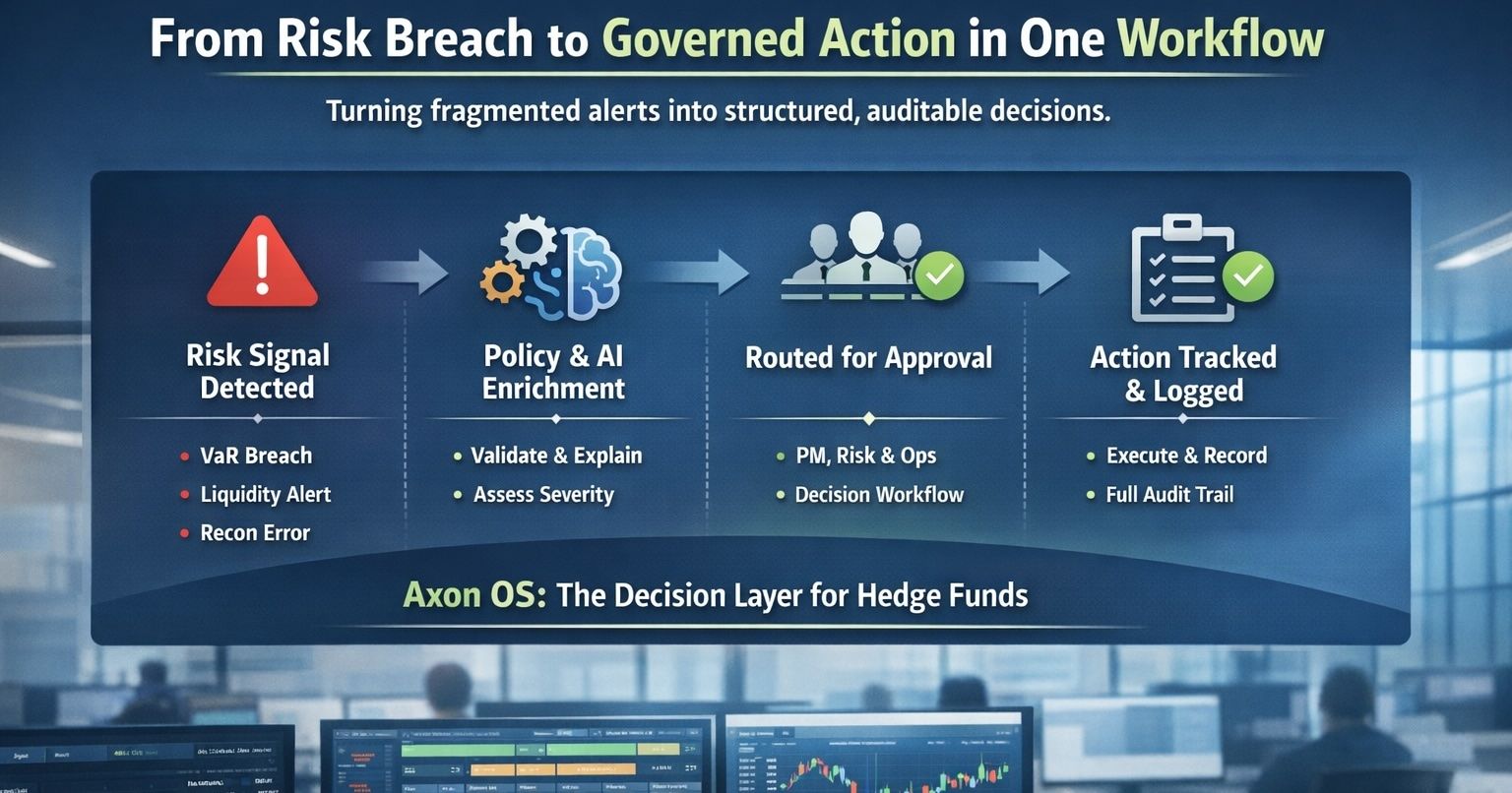
Use Case: From Risk Breach to Governed Action
The Reality Inside Most Hedge Funds
Every day, your systems generate signals — VaR breaches, liquidity constraints, reconciliation mismatches, concentration risks.
What follows is rarely structured.
An analyst notices an alert. Additional data is pulled manually. Messages are exchanged across chat. A portfolio manager is looped in. Risk weighs in later.
By the time action is taken, context is diluted and time is lost.
The issue is not visibility.
It is the absence of a controlled path from signal to action.
What Axon OS Changes
Axon OS introduces a governed decision layer above your existing OMS, risk systems, and data infrastructure.
It does not replace your systems. It connects them and structures what happens after a signal is detected.
Instead of alerts triggering manual coordination, they initiate a defined decision workflow.
How a Risk Event Flows
A VaR breach is detected from an existing risk system.
The signal is validated against firm-defined policies. Severity is assigned, and required approvals are determined using deterministic logic aligned with internal controls.
AI then enriches the event by explaining what changed, identifying key drivers, and summarizing the situation in clear terms. It may suggest next steps, but it does not override policy or trigger execution.
The alert becomes a structured decision.
This decision is automatically routed to the relevant stakeholders — portfolio managers, risk officers, or operations — based on predefined approval structures.
Each participant operates with the same context, explanation, and options.
Approvals, rejections, and overrides are captured within the workflow. Actions are tracked. Nothing is implicit or lost.
What This Means for the COO
The COO gains a single operational control layer instead of relying on fragmented processes.
Signals become decisions.
Decisions follow defined paths.
Actions are visible and controlled.
Every step is auditable.
The Operational Shift
Without a system like Axon OS, scaling operations requires adding people to manage complexity.
With Axon OS, scaling comes from removing friction.
Decisions move faster because they are pre-structured.
Approvals happen in context.
Exceptions are handled consistently.
Why This Matters Now
As funds expand across strategies and data sources, the volume of signals increases exponentially.
Manual coordination does not scale.
Operational advantage comes from connecting risk, operations, and portfolio management into a single governed flow.
The Bottom Line
Axon OS is the decision layer between risk signals and operational action.
It transforms fragmented alerts into governed workflows that improve speed, control, and accountability.
Call to Action
See how a single risk breach moves through a governed workflow — from detection to approval — in minutes, not hours.