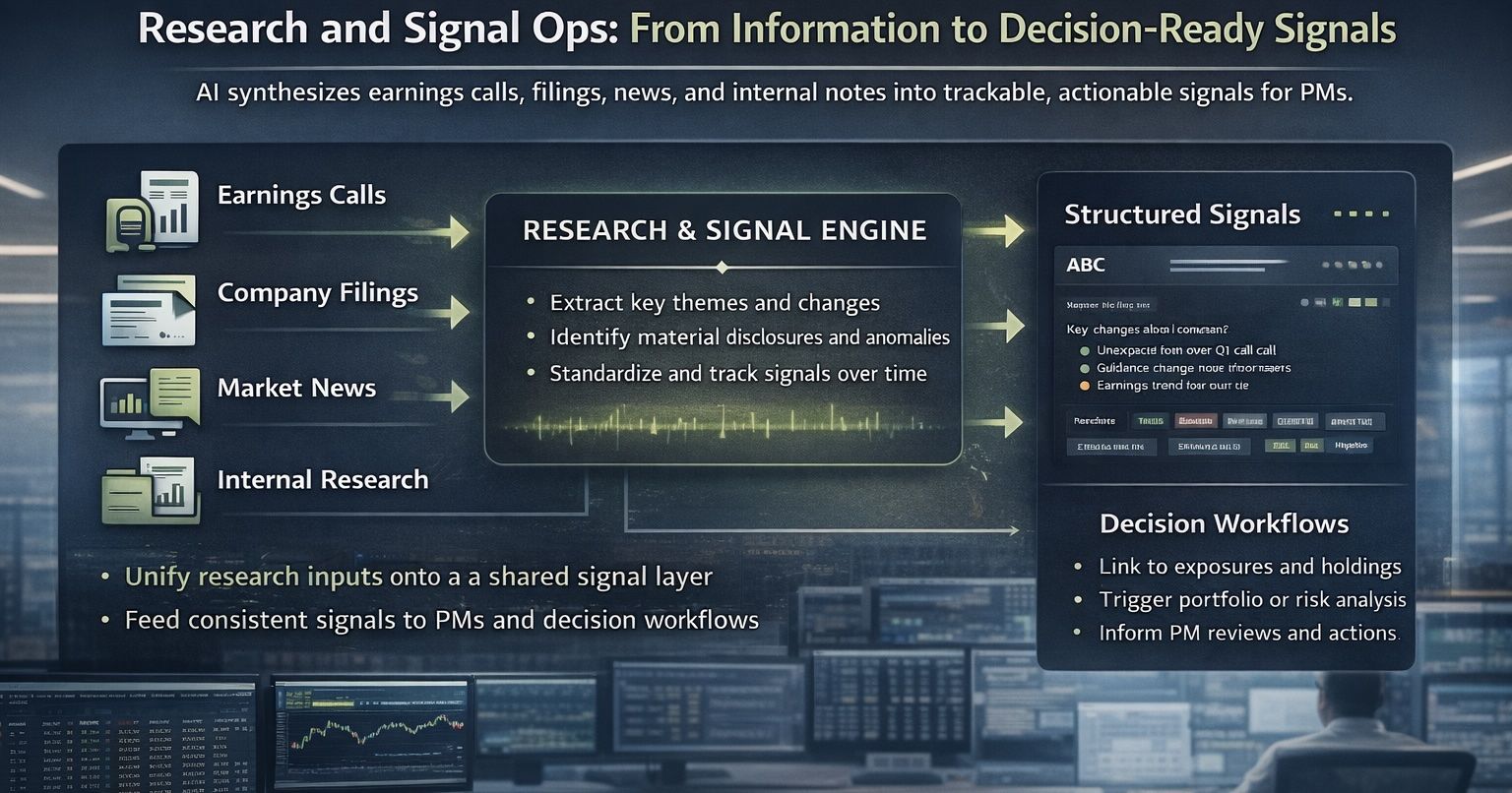
Use Case: Research and Signal Ops
The Reality of Research Workflows
Hedge fund research is no longer constrained by access to information.
It is constrained by the ability to process it.
Earnings calls, regulatory filings, news flow, alternative data, and internal notes all arrive continuously. Analysts are expected to absorb, interpret, and connect these inputs into actionable views.
In practice, this leads to fragmentation.
Important signals are buried in transcripts.
Insights are spread across documents and tools.
Different analysts interpret the same information differently.
Time is lost not in finding information, but in making sense of it.
What Axon OS Changes
Axon OS introduces a structured research-to-decision layer.
It ingests unstructured and semi-structured data across sources and converts it into consistent, decision-ready intelligence.
Instead of raw information flowing into individual workflows, it becomes part of a shared, governed system of insight.
How Information Becomes a Signal
New information enters the system continuously:
Earnings call transcripts
Company filings
Market-moving news
Internal analyst notes
Axon OS processes these inputs and extracts:
Key themes and changes
Management tone and sentiment shifts
Material disclosures and anomalies
Cross-source correlations
AI summarizes and structures the information, but does not stop at summarization.
It organizes outputs into comparable, consistent formats that can be tracked over time.
From Insight to Decision Context
Each synthesized output becomes part of a structured signal.
Signals are:
Linked to specific securities or portfolios
Tagged by relevance and impact
Connected across time and sources
Instead of reading multiple documents, a portfolio manager sees a consolidated view:
What changed
Why it matters
How it compares to prior signals
This creates a shared understanding across research and portfolio teams.
Continuous Signal Monitoring
Axon OS does not operate in snapshots.
It continuously monitors incoming information and updates signals as new data arrives.
When a meaningful shift is detected — in narrative, sentiment, or disclosure — it is surfaced as a structured event.
These events can be:
Reviewed
Routed
Connected to existing positions or exposures
Research becomes an active system, not a passive input.
What This Means for the COO
The COO gains operational control over research workflows.
Instead of relying on individual analyst processes, the organization benefits from:
Consistent signal generation
Reduced dependency on manual synthesis
Faster alignment between research and portfolio decisions
Information flow becomes structured, repeatable, and auditable.
The Operational Shift
Research scales not by adding more analysts, but by improving how information is processed.
Analysts spend less time reading and summarizing, and more time interpreting and acting.
Portfolio managers receive structured inputs instead of fragmented updates.
Decisions are based on consistent signals, not variable interpretations.
The Bottom Line
Axon OS transforms research from a fragmented, manual process into a structured signal engine.
It compresses the time between information intake and decision, while improving consistency, visibility, and control.
Call to Action
See how Axon OS converts research inputs into structured, decision-ready signals — in real time.