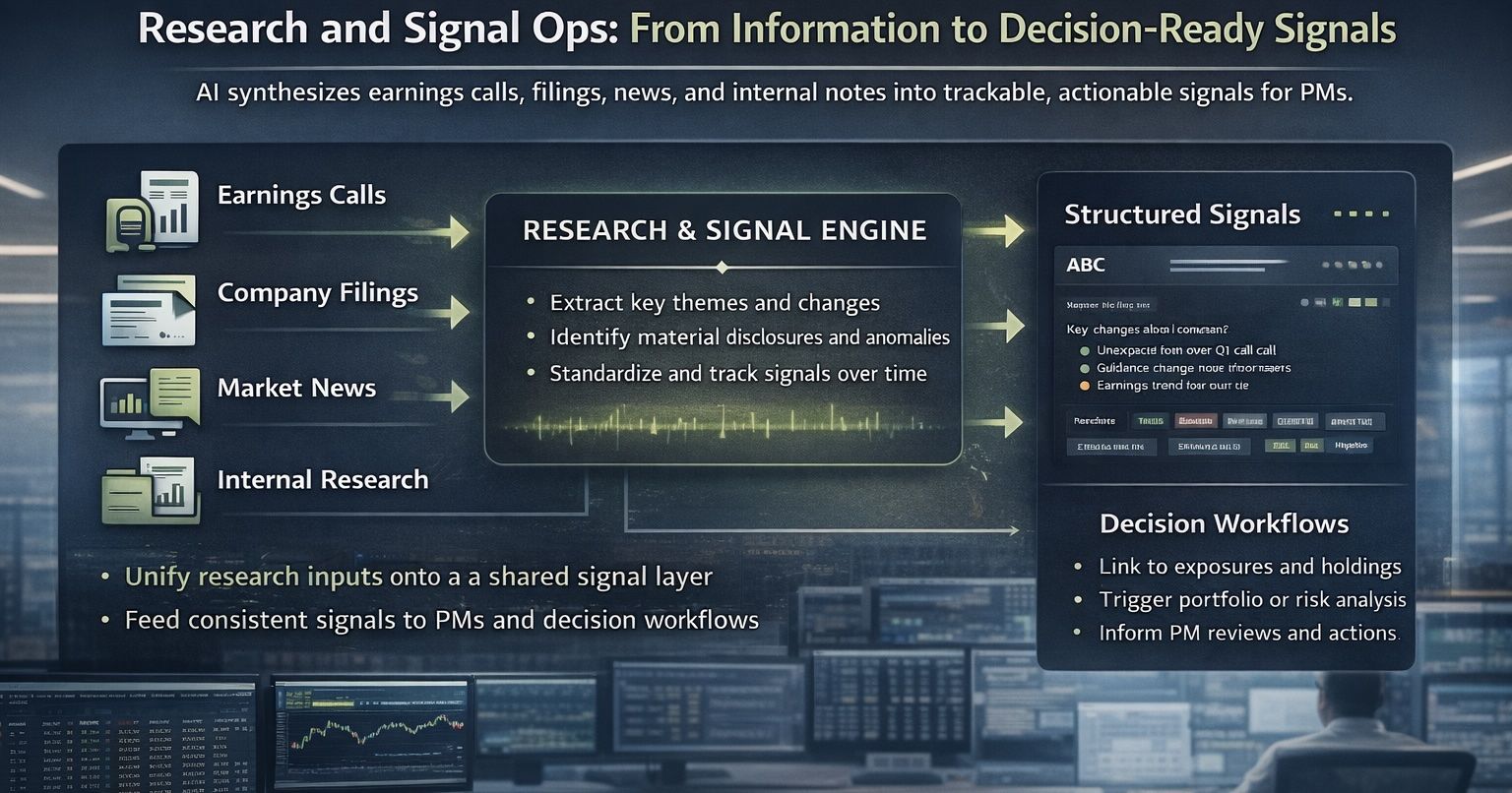
Use Case: Research and Signal Ops
The Reality of Research at Scale
Hedge funds are not limited by access to information.
They are limited by how quickly that information becomes usable.
Earnings calls, filings, news flow, and internal notes arrive continuously. Each piece may contain something material, but extracting that signal is manual, fragmented, and inconsistent.
Analysts read the same transcript and reach different conclusions.
Important changes are buried in long documents.
Connections across sources are often missed.
The bottleneck is not data.
It is the absence of a structured path from information to decision.
What Axon Risk Ops Changes
Axon Risk Ops introduces a signal layer between raw information and portfolio decisions.
It does not just summarize content.
It converts information into structured, trackable signals that can be used across workflows.
Instead of research living in documents and individual workflows, it becomes part of a shared system.
How Information Becomes a Signal
New inputs flow into the system continuously:
Earnings call transcripts
Company filings
Market-moving news
Internal research notes
Each input is processed and structured.
Key changes are extracted.
Narratives are compared to prior periods.
Material disclosures are identified.
Patterns across sources are connected.
AI is used to interpret and summarize, but the output is not free-form text.
It is structured into consistent, comparable formats.
From Signal to Decision Context
Each output becomes a signal tied to:
A specific company or asset
A time window
A level of importance
Signals are tracked over time, allowing teams to see:
What changed
How it evolved
What it means in context
Instead of reading multiple documents, a portfolio manager sees a consolidated view of relevant changes.
Research becomes directly usable.
Continuous Monitoring, Not Static Reports
The system continuously updates as new information arrives.
When a meaningful shift occurs — in sentiment, narrative, or disclosure — it is surfaced as a signal.
These signals can then:
Be reviewed by analysts
Be linked to portfolio exposures
Feed into risk or decision workflows
Research is no longer periodic. It becomes continuous and event-driven.
What This Means for the COO
The COO gains structure and control over research workflows.
Instead of relying on individual analyst processes, the organization operates on:
Consistent signal generation
Shared context across teams
Faster alignment between research and portfolio decisions
Research becomes a system, not a collection of documents.
The Operational Shift
Analysts spend less time processing raw information and more time interpreting it.
Portfolio managers receive structured inputs instead of fragmented updates.
Decisions are based on consistent signals, not variable interpretations.
The Bottom Line
Axon Risk Ops transforms research into a structured signal engine.
It compresses the time from information intake to decision, while improving consistency, visibility, and operational control.
Call to Action
See how Axon Risk Ops converts earnings, filings, and news into structured signals that feed directly into decision workflows.