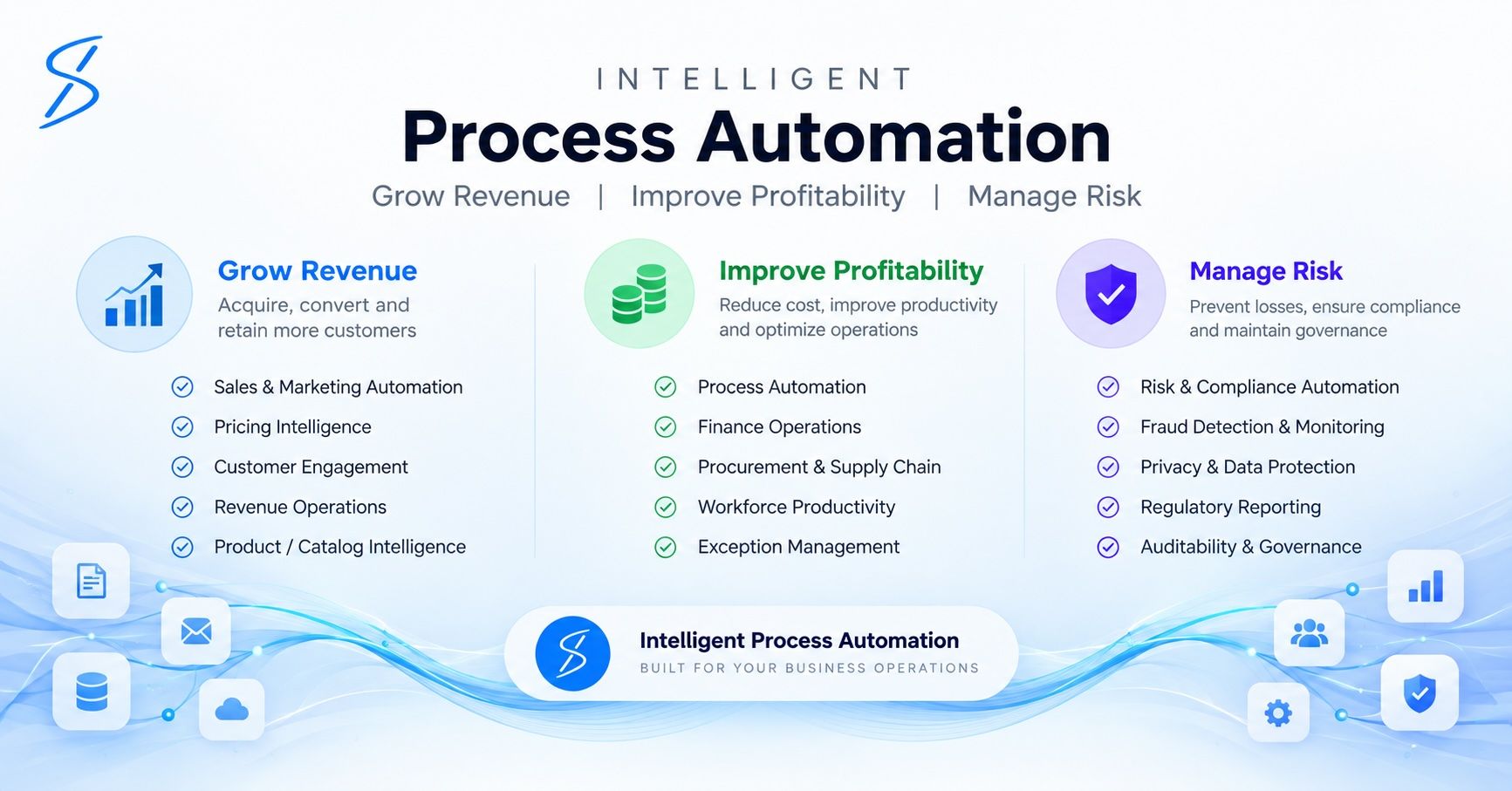

Intelligent Process Automation: The Operating Layer Between AI and the Enterprise
AI is becoming very good at understanding information. Automation is very good at executing repeatable tasks. Intelligent Process Automation brings the two together—and adds something enterprises have always needed: context, decisions, controls and accountability.
For years, enterprise automation followed a fairly simple formula.
A process was mapped. Rules were defined. A software bot followed those rules, often moving information from one system to another.
It worked well when the world behaved predictably.
But businesses rarely do.
A customer sends an unusual request. A supplier submits an invoice in a different format. A compliance rule changes. A risk limit is breached. A contract contains an exception. A shipment is delayed. A patient record is incomplete. A portfolio suddenly behaves differently from historical patterns.
These are not simply repetitive tasks.
They require understanding, context, judgment, action and sometimes human intervention.
That is where Intelligent Process Automation, or IPA, becomes important.
What is Intelligent Process Automation?
Intelligent Process Automation is the combination of workflow automation, artificial intelligence, enterprise data, integrations, decisioning and governance to automate business processes that previously required significant human intervention.
Traditional automation asks:
What rule should I execute?
IPA asks:
What is happening, what does it mean, what should happen next, am I authorized to do it, and when should a human be involved?
That difference is fundamental.
A conventional workflow might look like:
Receive request
      ↓
Check predefined rule
      ↓
Execute action
      ↓
Close task
An intelligent process can look like:
Receive request
      ↓
Understand the request
      ↓
Retrieve relevant data and context
      ↓
Interpret policies and business rules
      ↓
Assess the situation
      ↓
Determine next action
      ↓
Execute through enterprise systems
      ↓
Verify outcome
      ↓
Escalate exceptions when necessary
      ↓
Record everything for audit and improvement
IPA therefore isn’t simply RPA with an LLM attached.
It is an operating architecture for making business processes increasingly capable of understanding, deciding and acting.
Why IPA is becoming important
Most large organizations do not have a shortage of software.
They have a shortage of connected processes.
A single business transaction can pass through a CRM, ERP, data warehouse, email system, document repository, ticketing platform, approval workflow and several spreadsheets.
The employee becomes the integration layer.
They read the email.
They open the spreadsheet.
They search the CRM.
They download the document.
They check the policy.
They make a decision.
They send an approval request.
They update another system.
And then someone else checks their work.
The technology exists. What is missing is often an intelligent layer connecting it.
IPA aims to put that layer between people, processes, data and enterprise systems.
The Components of Intelligent Process Automation
An effective IPA platform is not a single technology. It is a collection of capabilities working together.
1. Process and Workflow Orchestration
The first layer defines how work moves through the organization.
It includes:
- Workflow orchestration
- Business rules
- Process states
- Approvals
- SLAs
- Escalations
- Task assignment
- Human-in-the-loop workflows
- Exception handling
- Process dependencies
The workflow engine provides structure.
AI can make decisions within that structure, but the organization still needs to know where a process starts, what states it can enter, who owns it and how it ends.
2. Enterprise Integration
An intelligent process is only useful if it can actually do something.
The integration layer connects IPA to:
- ERP systems
- CRM platforms
- Core banking systems
- EHR systems
- Legal systems
- Data warehouses
- Databases
- SaaS applications
- Messaging platforms
- APIs
- Legacy applications
- Browser and desktop applications
This is the execution fabric of IPA.
The objective is not to replace every enterprise application.
It is to allow intelligence to operate across them.
3. Data and Context
AI cannot make good decisions with the wrong context.
IPA therefore needs access to the information surrounding a process.
That may include:
- Structured enterprise data
- Customer records
- Transaction data
- Documents
- Emails
- Contracts
- Policies
- Conversations
- Knowledge bases
- Historical cases
- Operational data
- External information
Technologies such as RAG, semantic search, vector databases and knowledge graphs can help assemble the relevant context at the moment a decision is being made.
The important concept is not simply retrieval.
It is contextual retrieval.
The system should retrieve what is relevant to this customer, this transaction, this matter, this portfolio or this case.
4. Intelligence
This is the layer that allows the process to understand information.
It can include:
- Large language models
- Small specialized models
- Classification
- Extraction
- Summarization
- Document understanding
- Anomaly detection
- Forecasting
- Prediction
- Semantic reasoning
- Recommendation
Different processes require different forms of intelligence.
A document-processing workflow may need extraction.
A risk workflow may need anomaly detection and reasoning.
A customer-service workflow may need language understanding.
A pricing workflow may need forecasting and optimization.
IPA should therefore not be built around the assumption that one model does everything.
5. Agents and Decisioning
The intelligence layer understands.
The agent layer acts on that understanding.
An agent can:
- Plan a sequence of actions
- Select appropriate tools
- Retrieve information
- Apply policies
- Call enterprise systems
- Create tasks
- Request approval
- Execute actions
- Monitor results
- Escalate exceptions
A risk operations workflow, for example, could become:
Detect unusual portfolio movement
        ↓
Retrieve portfolio context
        ↓
Check risk limits
        ↓
Review relevant policies
        ↓
Investigate contributing factors
        ↓
Classify severity
        ↓
Create risk case
        ↓
Notify responsible team
        ↓
Request approval if required
        ↓
Execute permitted remediation
        ↓
Record decision and evidence
This is substantially different from automating a single task.
The automation is operating at the process level.
6. Execution
The system eventually has to do the work.
Execution can include:
- Creating records
- Updating databases
- Sending messages
- Generating documents
- Creating tickets
- Updating CRM records
- Submitting forms
- Triggering APIs
- Starting workflows
- Updating ERP systems
- Performing browser automation
- Generating reports
- Initiating downstream processes
This is where AI moves from being an assistant to becoming an operational participant.
But that participation must be controlled.
7. Governance, Risk and Security
Enterprise automation cannot simply ask:
“Can the AI do this?”
It must also ask:
“Should the AI be allowed to do this?”
Governance therefore becomes a core component of IPA.
It includes:
- Identity and access control
- Role-based permissions
- Data privacy
- PII protection
- PHI protection
- Data masking
- Policy enforcement
- Approval controls
- Audit trails
- Model governance
- Agent permissions
- Data residency
- Compliance controls
- Explainability
- Human oversight
An agent that can execute a transaction but cannot prove why, under whose authority and using what information is difficult to deploy in a regulated enterprise.
8. Observability and Continuous Optimization
Automation itself needs to be monitored.
Organizations need to understand:
- What processes are running?
- How long do they take?
- Where are they failing?
- How often do humans intervene?
- What does automation cost?
- Which decisions are being escalated?
- Where are bottlenecks occurring?
- Which workflows are generating value?
- Where are errors occurring?
This creates a feedback loop:
Observe → Measure → Diagnose → Improve → Automate further
IPA should therefore become progressively better at running the process.
The IPA Architecture
These components come together into a larger operating architecture.
                    PEOPLE
             Employees / Customers
                       │
                       ▼
              PROCESS & WORKFLOW
         Rules • SLAs • Approvals • Tasks
                       │
                       ▼
              INTELLIGENCE & AGENTS
       Reasoning • Planning • Decisioning
                       │
          ┌────────────┴────────────┐
          ▼                         ▼
   DATA & CONTEXT              KNOWLEDGE
   RAG • Search • DBs       Policies • Documents
   Graphs • History        Procedures • Expertise
          └────────────┬────────────┘
                       ▼
                   EXECUTION
          APIs • Tools • RPA • MCP
                       │
                       ▼
              ENTERPRISE SYSTEMS
       ERP • CRM • EHR • Core Systems
                       │
                       ▼
          OBSERVABILITY & GOVERNANCE
       Security • Risk • Audit • Privacy
The important point is that governance and observability operate across the entire architecture, rather than being an afterthought.
How IPA Changes Across Industries
There is no universal IPA workflow.
The technology is similar.
The processes are not.
The value comes from applying the architecture to the economics and operating model of each industry.
Financial Services
Financial institutions operate some of the world’s most process-intensive businesses.
Risk, compliance, trading, lending, payments and operations all generate large volumes of structured and unstructured information.
IPA can connect these processes rather than automating them individually.
High-value processes
| Area | Examples |
|---|---|
| Risk | Limit monitoring, breach investigation, portfolio analysis |
| Operations | Trade processing, reconciliations, settlements |
| Compliance | KYC, AML, regulatory reporting |
| Lending | Underwriting, document review, approvals |
| Wealth | Client servicing, portfolio monitoring |
| Finance | Reconciliation, close, reporting |
| Customer operations | Service, onboarding, exceptions |
The opportunity is particularly significant in exception management.
A system that merely processes normal transactions automates the easy part.
An intelligent system can investigate the unusual ones.
Insurance
Insurance combines documents, rules, risk assessment and high-volume transactions.
Claims are a natural IPA environment because they often involve forms, images, policies, correspondence, third-party information and human decisions.
High-value processes
- Claims intake
- Claims assessment
- Underwriting
- Policy servicing
- Fraud detection
- Document review
- Customer communications
- Renewals
- Broker operations
- Regulatory compliance
IPA can move a claim from:
submission → document understanding → policy validation → assessment → fraud screening → decision → settlement → customer communication
while routing ambiguous cases to humans.
Healthcare and Life Sciences
Healthcare is one of the most complex process environments because administrative work exists alongside highly sensitive information.
IPA can support the operational layer without attempting to replace clinical judgment.
High-value processes
- Patient onboarding
- Provider onboarding
- Prior authorization
- Claims administration
- Medical coding
- Document processing
- Revenue-cycle operations
- Appointment workflows
- Compliance
- Privacy operations
- Research administration
For healthcare, governance is particularly important.
An intelligent workflow must understand what information it can access, what it can do with it and when a human must intervene.
Legal
Legal work is inherently contextual.
A matter may contain contracts, emails, pleadings, judgments, research, correspondence, deadlines and internal knowledge.
That makes legal operations particularly suitable for contextual IPA.
High-value processes
- Matter intake
- Legal research
- Document review
- Contract lifecycle management
- Discovery
- Litigation workflows
- Legal billing
- Compliance
- Client communications
- Document management
The important shift is from:
AI that answers a legal question
to:
AI that operates within the legal matter and helps move the matter forward.
Manufacturing
Manufacturing connects physical operations with procurement, suppliers, quality, logistics and finance.
A problem on the factory floor can quickly become a supply-chain problem.
High-value processes
- Procurement
- Supplier management
- Production planning
- Quality control
- Maintenance
- Inventory
- Logistics
- Engineering change management
- Safety
- Compliance
IPA can connect signals from machines, suppliers, ERP systems and operational teams into a coordinated workflow.
Retail and D2C
Retail has one of the clearest connections between automation and revenue.
Every operational decision can affect conversion, margin, inventory or customer experience.
High-value processes
- Catalog management
- Product enrichment
- Pricing intelligence
- Demand forecasting
- Marketing
- Customer engagement
- Order management
- Inventory
- Supplier management
- Returns
- Retail and wholesale synchronization
Consider pricing.
A conventional system changes a price according to predefined rules.
An intelligent pricing workflow can consider:
market conditions + inventory + demand + competitor signals + costs + margins + business policies
and recommend or execute an appropriate action.
Logistics and Supply Chain
Supply chains are essentially networks of processes and exceptions.
Orders move between organizations, warehouses, carriers, ports and customers.
The exception is often where the cost appears.
High-value processes
- Order management
- Shipment tracking
- Freight documentation
- Customs
- Carrier management
- Warehouse operations
- Invoice reconciliation
- Supplier management
- Demand forecasting
- Exception management
IPA can monitor the process continuously and intervene when something deviates from the expected path.
Pharmaceuticals
Pharmaceutical companies operate under extensive regulatory and documentation requirements.
High-value processes
- Clinical-trial operations
- Regulatory submissions
- Pharmacovigilance
- Quality management
- Medical information
- Document review
- Manufacturing quality
- Supplier compliance
- Regulatory reporting
Here, IPA is less about simply reducing headcount and more about reducing process friction while maintaining traceability and control.
Telecom
Telecom combines enormous transaction volumes with complex infrastructure.
High-value processes
- Network monitoring
- Service assurance
- Customer support
- Billing
- Revenue assurance
- Fraud management
- Customer onboarding
- Service provisioning
- Capacity planning
- Field operations
- Regulatory compliance
The business impact can span revenue, network reliability, customer retention and operating costs.
Energy and Utilities
Energy and utilities operate physical assets whose failures can have significant operational and financial consequences.
High-value processes
- Asset monitoring
- Predictive maintenance
- Grid operations
- Load forecasting
- Outage management
- Field-service management
- Energy trading
- Metering
- Billing
- Regulatory reporting
- Sustainability reporting
IPA can connect asset signals with operational workflows, ensuring that an anomaly becomes an action rather than simply another alert.
Real Estate
Real estate contains a surprisingly large number of document-heavy and transaction-heavy processes.
High-value processes
- Lead management
- Property marketing
- Customer onboarding
- Document verification
- Contract lifecycle management
- Pricing
- Project management
- Facility management
- Lease management
- Asset management
- Compliance
The opportunity exists across developers, property managers, REITs, brokers and commercial real estate operators.
Construction and Infrastructure
Construction is fundamentally a coordination problem.
Owners, contractors, subcontractors, engineers, suppliers, regulators and project managers all operate around a common project.
High-value processes
- Project planning
- Tendering
- Procurement
- Contract management
- Engineering document management
- Site operations
- Progress tracking
- Cost control
- Safety
- Quality
- Subcontractor management
- Asset handover
IPA can connect project information and identify deviations before they become expensive project problems.
Travel and Hospitality
Travel businesses operate around customer journeys.
That makes the customer experience itself a process that can be intelligently orchestrated.
High-value processes
- Reservations
- Check-in and check-out
- Customer service
- Concierge
- Dynamic pricing
- Loyalty
- Marketing
- Vendor management
- Inventory
- Revenue management
- Guest feedback
The objective is not simply to automate customer service.
It is to create a connected customer journey.
Government and Public Sector
Public-sector processes are often large-scale, document-heavy and dependent on multiple departments.
High-value processes
- Citizen services
- Applications
- Permits
- Document verification
- Grievance management
- Procurement
- Program management
- Compliance
- Policy research
- Interdepartmental workflows
- Public communications
Here, transparency and accountability are as important as efficiency.
Education
Education institutions have extensive administrative processes surrounding students, faculty and institutions.
High-value processes
- Student recruitment
- Admissions
- Onboarding
- Academic administration
- Scheduling
- Assessment
- Student support
- Fee operations
- Faculty administration
- Accreditation
- Alumni engagement
IPA can allow institutions to spend less operational effort moving information and more effort supporting students and educators.
Agriculture and Food
Agriculture and food have traditionally suffered from fragmented information across farmers, FPOs, processors, exporters, logistics providers and buyers.
IPA can connect the supply chain.
High-value processes
- Farmer onboarding
- Procurement
- Crop planning
- Quality grading
- Traceability
- Inventory
- Warehousing
- Logistics
- Pricing
- Demand forecasting
- Export documentation
- Compliance
The result can be a more transparent connection between farm, processor, marketplace and consumer.
Automotive
Automotive companies operate across manufacturing, suppliers, dealers and after-sales networks.
High-value processes
- Product engineering
- Bill of materials
- Supplier management
- Procurement
- Production planning
- Quality
- Inventory
- Dealer management
- Sales
- Warranty
- After-sales
- Fleet operations
- EV and battery operations
IPA can connect the vehicle’s lifecycle rather than treating each function as a separate automation problem.
Media and Advertising
Media companies operate in a world where content, audiences, campaigns and channels constantly change.
High-value processes
- Campaign planning
- Content production
- Audience segmentation
- Media buying
- Campaign optimization
- Social media
- Influencer management
- Attribution
- Brand monitoring
- Content moderation
- Ad compliance
- Billing
Here, IPA can combine creative workflows with data-driven optimization.
The Common Pattern Across Industries
Despite the differences between industries, many IPA opportunities follow the same pattern.
| Business challenge | IPA capability |
|---|---|
| Too much manual work | Workflow automation |
| Too many documents | Document intelligence |
| Information scattered across systems | Integration + contextual retrieval |
| Too many exceptions | AI-driven investigation |
| Slow decisions | Decision intelligence |
| Repetitive customer interactions | AI agents |
| Complex approvals | Human-in-the-loop workflows |
| Compliance burden | Policy + governance automation |
| Poor visibility | Observability |
| Operational leakage | Continuous monitoring |
| Difficult optimization | AI-driven recommendations |
The technology changes only slightly.
The business process changes dramatically.
How IPA Improves the Bottom Line
The easiest way to understand IPA’s financial impact is to look at the cost structure of a process.
Suppose a company has 1,000 employees spending part of their working day:
- searching for information,
- entering data,
- checking documents,
- coordinating approvals,
- investigating exceptions,
- preparing reports,
- reconciling systems.
IPA can reduce the amount of human effort required for those activities.
But cost reduction is only one dimension.
Bottom-line levers
1. Lower operating costs
Automate repetitive work and reduce manual processing.
2. Higher employee productivity
Allow employees to handle more complex work rather than administrative coordination.
3. Lower error rates
Reduce errors caused by manual data entry and process handoffs.
4. Lower operational leakage
Identify missed charges, incorrect payments, duplicate transactions, policy violations and other forms of leakage.
5. Better resource utilization
Use people, infrastructure, inventory and capital more efficiently.
6. Faster cycle times
A process completed in hours rather than days can reduce working capital and operational friction.
How IPA Improves the Top Line
The top-line opportunity is often more interesting.
IPA can make revenue processes faster and more intelligent.
Revenue levers
Acquire
Automate lead qualification, outreach, onboarding and conversion processes.
Convert
Give sales and service teams immediate access to customer context.
Price
Use market, demand, inventory and cost signals to improve pricing decisions.
Expand
Identify cross-sell and upsell opportunities.
Retain
Detect customer dissatisfaction and intervene earlier.
Serve
Make customer interactions faster and more personalized.
Optimize
Continuously improve campaigns, channels, inventory and revenue operations.
The distinction is important:
Automation doesn’t have to mean doing the same work cheaper. It can mean making the business capable of doing more valuable work.
IPA and Risk Management
Risk should not be treated as a separate department sitting outside automation.
It should be embedded inside the process.
Consider a procurement workflow.
A conventional automation system might:
Receive purchase request → create purchase order.
An intelligent risk-aware workflow might:
Receive request → validate supplier → check sanctions → assess contract → compare pricing → check approval authority → identify anomalies → determine risk → route for approval → create purchase order → record evidence.
The process is now automated and controlled.
That distinction matters particularly in financial services, healthcare, pharmaceuticals, legal, government and other regulated industries.
Three Business Outcomes
IPA ultimately connects three objectives that are often managed separately.
                 INTELLIGENT PROCESS AUTOMATION

                         ┌───────────┐
                         │  TOP LINE │
                         │  GROWTH   │
                         └─────┬─────┘
                               │
                               ▼
                         ┌───────────┐
                         │ BUSINESS  │
                         │  PROCESS  │
                         └─────┬─────┘
                               │
              ┌────────────────┼────────────────┐
              ▼                ▼                ▼
         ↑ Revenue        ↓ Operating       ↓ Risk
                            Cost             & Loss
A well-designed IPA program should therefore ask three questions:
Can we grow more?
Revenue, conversion, pricing, retention and customer experience.
Can we operate better?
Cost, productivity, cycle time, utilization and process efficiency.
Can we control better?
Risk, compliance, fraud, privacy, errors and operational resilience.
The most powerful applications affect all three.
From Automation to Process Intelligence
The next stage of enterprise automation is not simply more bots.
It is process intelligence.
A process begins with rules.
Then it gains access to data.
Then it gains contextual understanding.
Then it can make decisions.
Then it can execute.
Then it can observe the outcome.
And eventually it can help improve the process itself.
RULES
  ↓
AUTOMATION
  ↓
INTELLIGENCE
  ↓
DECISIONING
  ↓
AGENTIC EXECUTION
  ↓
OBSERVABILITY
  ↓
CONTINUOUS OPTIMIZATION
That is the evolution from RPA to IPA to increasingly autonomous business operations.
The Human Does Not Disappear
The most useful enterprise automation is not necessarily the one with the fewest humans.
It is the one that puts humans where their judgment matters most.
An IPA system should be able to distinguish between:
“I can do this.”
“I can do this, but I need approval.”
“I don’t have enough information.”
“This falls outside my authority.”
“This is an exception and should go to a human.”
That is what makes enterprise automation trustworthy.
The objective is not human-free processes.
It is higher-value human involvement.
What Makes an IPA Program Successful?
Technology alone does not make IPA successful.
The most important starting point is the process itself.
A useful assessment looks at:
| Question | Why it matters |
|---|---|
| How frequently does the process run? | Determines automation volume |
| How much human effort is involved? | Determines productivity opportunity |
| How many systems are involved? | Determines integration complexity |
| How much unstructured information exists? | Determines AI opportunity |
| How many exceptions occur? | Determines intelligence requirement |
| What is the cost of failure? | Determines governance requirements |
| How much revenue does it influence? | Determines topline potential |
| How much cost does it influence? | Determines bottom-line potential |
| What regulatory obligations exist? | Determines control requirements |
| Can success be measured? | Determines business case |
The right question isn’t:
“Where can we use AI?”
It is:
“Which business processes would materially improve if they could understand, decide and act?”
The Enterprise Opportunity
The interesting thing about IPA is that it does not require an organization to replace its existing technology stack.
The ERP can remain.
The CRM can remain.
The data warehouse can remain.
The document management system can remain.
The core banking platform can remain.
The EHR can remain.
IPA can become the intelligent operating layer across them.
That creates a different model for enterprise AI.
Instead of deploying dozens of disconnected AI copilots, an organization can progressively build AI-powered processes that understand the organization’s data, policies and systems—and operate within defined boundaries.
From AI Assistants to AI-Powered Operations
The first generation of enterprise generative AI largely focused on assistance:
“Ask the AI a question.”
The next generation moves toward:
“Give the AI a task.”
IPA takes that one step further:
“Give the system responsibility for a controlled business process.”
That process may be a financial risk investigation.
A healthcare authorization.
A legal matter.
A manufacturing exception.
A logistics disruption.
A customer onboarding journey.
A pricing decision.
A government application.
Or a supply-chain workflow.
The underlying architecture remains remarkably similar.
Context. Intelligence. Workflow. Decisioning. Execution. Governance.
The industry determines what the system knows and what it is allowed to do.
The New Enterprise Automation Stack
The future of enterprise automation is therefore unlikely to be a choice between RPA, workflows, AI or agents.
It will be a combination of them.
                 BUSINESS OUTCOMES
          ┌──────────┬──────────┬──────────┐
          │ TOP LINE │ BOTTOM   │   RISK   │
          │  GROWTH  │  LINE    │ & CONTROL│
          └──────────┴──────────┴──────────┘
                       ▲
                       │
              INTELLIGENT PROCESSES
                       ▲
                       │
       ┌───────────────┼────────────────┐
       │               │                │
   WORKFLOWS        AI AGENTS       DECISIONING
       │               │                │
       └───────────────┼────────────────┘
                       │
              DATA + CONTEXT + RAG
                       │
                       ▼
             ENTERPRISE INTEGRATIONS
                       │
                       ▼
            SYSTEMS OF RECORD
The goal is not to make every process autonomous.
The goal is to make every important process intelligently executable.
That is the promise of Intelligent Process Automation.
A final way to think about IPA
Traditional automation makes a process faster.
AI makes a system smarter.
Intelligent Process Automation brings those capabilities together so that a business process can understand what is happening, retrieve the right context, make or support a decision, execute the appropriate action, involve a human when necessary, and maintain the controls required by the enterprise.
And that is why IPA is becoming less about automating individual tasks and more about redesigning how businesses operate.
The future of enterprise AI is not just answering questions. It is operating processes.